


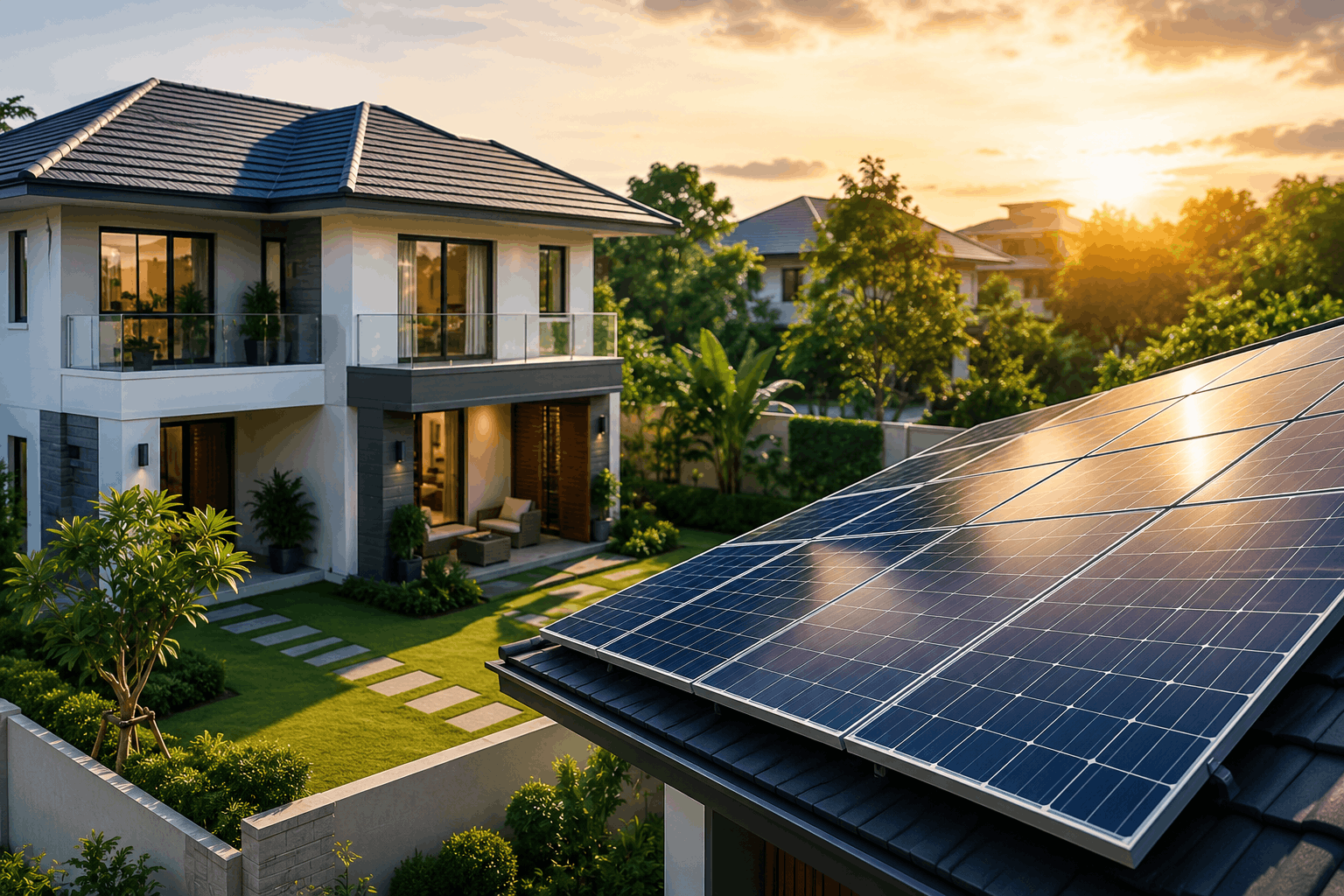
Villas have something apartments rarely offer: a rooftop that’s entirely yours, with no RWA vote needed to put solar panels on it. If you’ve ever wondered whether that roof space is worth converting into a power plant, the honest answer is: for most villa owners in Bangalore, yes — and the savings are bigger than most people expect.
| Quick AnswerA correctly sized rooftop solar system (3–5 kW) on a villa can cut electricity bills by 70–90%, saving roughly ₹4,000–₹7,500 a month. With the PM Surya Ghar subsidy (up to ₹78,000), payback typically takes 3–6 years. Over 25 years, total savings can reach ₹12–20 lakh. |
Key Takeaways
- A 5 kW rooftop system can offset up to 90% of a typical villa’s electricity consumption.
- Payback period is 3–6 years with the government subsidy, 5–7 years without it.
- Electricity tariffs are rising 6–10% a year, which makes solar savings grow larger every year you own the system.
- Villas are naturally well-suited to solar — larger private rooftops, no RWA approval process, and typically less shading than dense apartment blocks.
- The PM Surya Ghar Muft Bijli Yojana offers a subsidy of up to ₹78,000 for systems up to 3 kW.
How Much Can a Villa Actually Save on Electricity with Solar?
A well-sized system offsetting 80–90% of consumption delivers savings of roughly ₹3,800–₹7,500 a month for most villa households, depending on system size and how much electricity you use. Multiply your expected monthly solar generation (in kWh) by your tariff rate, subtract minimal maintenance cost, and that’s your net monthly saving — a simple calculation, but one most homeowners never actually run before deciding.
What Size Solar System Does a Villa Need?
Sizing is the single most important decision — oversizing wastes money on capacity you won’t use, and undersizing means you’re still paying a meaningful electricity bill every month.
| System size | Typical monthly bill it suits | Approx. monthly savings |
| 3 kW | ₹2,500–₹4,000 | ₹2,000–₹3,500 |
| 5 kW | ₹4,000–₹7,000 | ₹3,800–₹7,500 |
| 7–10 kW | ₹8,000+ | ₹7,000–₹12,000+ |
Use your current monthly electricity bill in units (kWh) as your starting point, then size the system to your actual consumption pattern rather than to the largest roof area you have available.
The PM Surya Ghar Subsidy — What You Actually Get
Launched to make rooftop solar affordable at scale, the PM Surya Ghar Muft Bijli Yojana offers a subsidy of up to ₹78,000 for residential systems up to 3 kW, credited as a direct benefit transfer to your bank account within about 30 days of your DISCOM commissioning the net meter.
You’ll need an Aadhaar card, your latest electricity bill with consumer number, a cancelled cheque, and property ownership proof (or an NOC if the property is rented) — your installer typically handles the DISCOM paperwork on your behalf.
Payback Period — When Does Solar Pay for Itself?
The average residential payback period in India in 2026 is 3.5–6 years after the subsidy, and 5–7 years without it. States with higher electricity tariffs — above roughly ₹9/unit — tend to see faster payback, often under 4 years. Once the system pays for itself, electricity is effectively free for the remaining 15–20+ years of the panels’ working life.
Why Villas Are Especially Well-Suited to Solar
- Larger private rooftop area than most apartments, with no shared-roof constraints
- No RWA vote or building-society approval process to install — it’s your roof, your decision
- Lower-density layouts typically mean less shading from neighbouring structures
- Villa owners can size the system to their own consumption without negotiating shared-installation costs with neighbours
Net Metering — How Selling Back Power Works
Net metering allows you to export any surplus solar electricity you generate back to the grid, receiving a bill credit in return. On sunny days when your system generates more than you use, that surplus doesn’t go to waste — it offsets your consumption on lower-generation days, including through the monsoon.
What Affects Your Actual Savings
- Roof orientation and shading — south-facing, unshaded roofs generate the most
- Your local DISCOM’s tariff rate — higher tariffs mean faster payback and higher absolute savings
- Seasonal variation — generation typically drops 30–50% during heavy monsoon months (July–August), though panels still generate from diffused light on cloudy days
- System quality — MNRE-certified equipment is required for subsidy eligibility and tends to perform more reliably over 25 years
FAQ
Q: How much can a villa actually save with solar panels?
A: Most villa households save ₹3,800–₹7,500 a month with a correctly sized 3–5 kW system, translating to 70–90% off a typical electricity bill.
Q: What is the payback period for solar on a villa in Bangalore?
A: Typically 3–6 years after the PM Surya Ghar subsidy, and 5–7 years without it.
Q: Do I need RWA approval to install solar on a villa?
A: No — since the rooftop is privately owned, villa owners can install solar without the approval process apartment owners often face with their housing society.
Q: Does solar still work during Bangalore’s monsoon season?
A: Yes, though generation typically drops 30–50% during heavy monsoon months; panels still generate electricity from diffused light even on cloudy days.
Q: What subsidy is available for residential solar in 2026?
A: The PM Surya Ghar Muft Bijli Yojana offers up to ₹78,000 for systems up to 3 kW, paid directly to your bank account after commissioning.
Looking at villas built with solar already in place? See Sportz Valley’s solar-powered villas in Sarjapur to skip the installation decision entirely.




Join The Discussion