

Every summer, the same Bangalore story repeats. Water tankers queue outside apartment gates, borewells run dry, and electricity bills climb as the AC works overtime.
No wonder more buyers now search for eco friendly villas in Bangalore. But here’s the catch: almost every brochure now says “green.” A few potted plants and one solar street light don’t make a home sustainable.
This guide shows you the 7 features that actually make a villa eco-friendly, how much they can save you, and the questions that separate real green homes from marketing.
Quick Answer: A truly eco-friendly villa cuts its energy, water and waste footprint through design, not decoration. Look for solar power, rainwater harvesting, a sewage treatment plant, natural light and ventilation, low-impact building materials, proper waste management and generous green cover.
Key Takeaways
- “Green” is a marketing word; check for specific features you can see and verify.
- Solar power and good natural light cut your electricity bills every month.
- Rainwater harvesting and recycled water reduce your dependence on tankers and borewells.
- Materials like terracotta blocks keep homes naturally cooler.
- Eco-friendly features lower running costs and add to long-term resale appeal.
What Is an Eco-Friendly Villa?
An eco-friendly villa (also called a sustainable or green villa) is a home designed to use less energy and water, produce less waste, and stay comfortable with less reliance on air-conditioning and tankers.
The key word is designed. True sustainability is built into the layout, materials and services from day one. It’s very hard to add later.
Watch out for “greenwashing”
Greenwashing is when a project uses eco-friendly language without real features to back it up. Common signs include:
- Vague claims like “nature-inspired living” with no specific features listed
- Solar power only for common-area lights, not for homes
- Landscaped lawns that need heavy watering, counted as “green cover”
- No mention of how water is collected, treated or reused
A real green home can tell you exactly what it does, in numbers.
7 Features of a Truly Eco-Friendly Villa
1. Solar power for the home itself
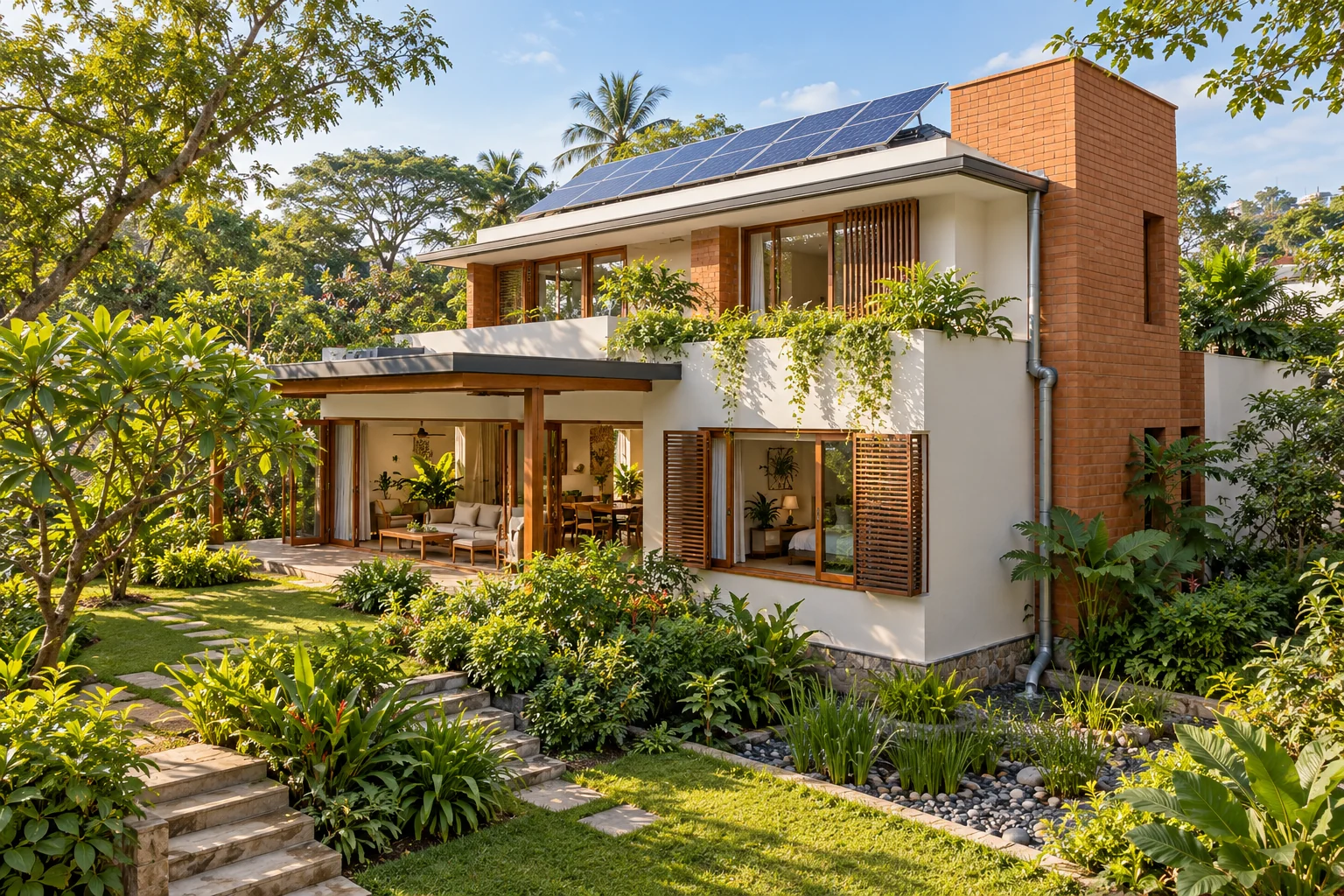
Rooftop solar panels that power your home, not just street lights, are the single biggest saver on electricity bills. Ask how many kilowatts each villa gets and which loads it covers.
2. Rainwater harvesting that is actually used
Under Bengaluru’s 2009 water-supply amendment, rainwater harvesting applies to existing buildings on sites of 2,400 sq ft and above and proposed buildings on sites of 1,200 sq ft and above. Ask the builder for the system design and the current BWSSB requirements.
The best projects don’t just meet the rule. They store large volumes and use the water for gardens, flushing and groundwater recharge.
3. A sewage treatment plant (STP) with reuse
An STP cleans the community’s wastewater so it can be reused for landscaping and flushing. That means less fresh water wasted on lawns.
4. Natural light and cross-ventilation
Skylights, large windows and open space around the home cut the need for lights by day and for AC in summer. Independent villas have a natural advantage here because they can have windows on all sides.
5. Low-impact building materials
Materials like terracotta blocks insulate better than ordinary bricks, so rooms stay cooler in heat. Locally sourced materials also cut transport emissions.
6. Proper waste management
Look for segregation at source, an organic waste composter on site and tie-ups for recycling dry waste. This keeps your community clean and reduces landfill.
7. Real green cover, not just lawns
Mature trees cool the air, cut dust and support birds. A project that plants and protects hundreds of trees will feel noticeably cooler than one with decorative lawns.
How Much Can an Eco-Friendly Villa Save You?
Green features cost a little more upfront, but they pay you back every month. Here’s where the savings come from.
| Feature | What it saves | How to estimate it |
|---|---|---|
| Rooftop solar | Electricity bills | As a common rule of thumb, 1 kW of solar produces about 4 units a day in sunny cities like Bangalore. Multiply by your BESCOM rate. |
| Rainwater harvesting | Tanker and water bills | Ask the builder for storage capacity in litres and how many dry-season days it covers. |
| STP + recycled water | Fresh water for gardens and flushing | Ask what share of non-drinking water comes from recycling. |
| Natural light + ventilation | Lighting and AC costs | Visit at noon and in the evening; note how many lights and fans you’d need. |
| Terracotta or insulating walls | AC use in summer | Feel the indoor temperature on a hot afternoon site visit. |
A quick example: a home with a 3 kW solar system could generate around 12 units a day, or roughly 360 units a month. For many families, that covers a big share of daytime power use.
The real gain is security. When the city faces a water shortage, a community that stores and recycles its own water feels the impact far less.
8 Questions to Ask Before You Book a “Green” Villa
Take these to your site visit. A genuinely sustainable project will answer them with numbers, not adjectives.
- How many kW of solar does each villa get, and what does it power?
- How many litres of rainwater can the community store?
- Is there an STP, and where does the treated water go?
- What building materials are used for the walls, and why?
- How many trees are planted, and are any existing trees kept?
- How is wet and dry waste handled on site?
- Do the homes have skylights, cross-ventilation and windows on all sides?
- Is the project RERA-registered, so these promises are on record?
Here’s what good answers look like in a real project. Madhura Gardens in Varthur, near Whitefield, uses solar-powered homes, terracotta blocks and double-height skylights. It also offers rainwater harvesting that can store up to 4 lakh litres, STP-recycled water and more than 1,000 trees across 6 acres. You can see the full details as one example of sustainable gated villas in Whitefield.
Buyers looking at green villas on Sarjapur Road can use the same eight questions to compare projects there.
Are Eco-Friendly Villas Worth It?
Short answer: Yes, for most buyers planning to live in their home for years. Eco-friendly villas cost slightly more upfront, but lower electricity and water bills, a cooler home and better resilience in water shortages pay you back over time. They also appeal to future buyers who care about running costs.
The benefits
- Lower monthly bills from solar power and less AC use
- Water security during Bangalore’s dry months
- A healthier home with fresh air, daylight and green surroundings
- Future-ready value, as more buyers ask about sustainability
The trade-offs
- Higher upfront price for solar systems and better materials
- Maintenance of solar panels, STP and harvesting systems, usually shared through community charges
- Greenwashing risk if you don’t verify claims
Think of it like buying a fuel-efficient car. You pay a bit more at the start, then save every time you fill up.
Frequently Asked Questions
What makes a villa eco-friendly?
An eco-friendly villa is designed to use less energy and water and produce less waste. Key features include solar power, rainwater harvesting, a sewage treatment plant, natural light and ventilation, insulating materials, waste management and real green cover.
Are eco-friendly villas more expensive in Bangalore?
They usually cost a little more upfront because of solar systems, better materials and water infrastructure. Over time, lower electricity and water bills recover much of that extra cost.
Is rainwater harvesting mandatory in Bangalore?
Yes. BWSSB rules require rainwater harvesting for new buildings on sites of 30×40 ft and above, and for larger existing properties. Non-compliance attracts a penalty on the water bill.
Why are terracotta blocks used in green homes?
Terracotta blocks are made from natural clay and insulate well. They keep indoor spaces cooler in summer, which reduces the need for air-conditioning.
How can I tell if a villa project is greenwashing?
Ask for specific numbers: solar capacity per home, litres of rainwater stored, trees planted, and how treated water is reused. Vague answers or features limited to common areas are warning signs.
Build a Future That Feels Good to Live In
A truly green home isn’t about a label on a brochure. It’s about cooler rooms in April, a full water tank in a dry summer, and lower bills every month for years.
You now know the seven features that matter, how to estimate what they save, and the eight questions that cut through marketing. That makes you a sharper buyer than most.
So take your checklist to every site visit and ask for the numbers. When you’re ready to compare options, you can explore eco-friendly luxury villas in Bangalore and find a home that’s good for your family and the city you live in.